Joshua Lawrence

Regional Australia is not a side market. Its regions account for around 40% of national economic output, so a regional business growth strategy for Australia should connect local business capability with public incentives, infrastructure investment and regional collaboration. Growth depends on more than location; it depends on building the partnerships and operating capacity to turn opportunity into durable results.
Regional opportunity comes with real constraints. Distance, workforce needs and infrastructure gaps can pressure businesses, while disconnected projects may struggle to gain momentum. Collaboration can turn shared priorities into stronger proposals and practical economic development.
This article explains how government incentives and infrastructure investment may support regional businesses, why collaboration matters, and how strategic project development can strengthen the case for growth. It covers where regional businesses can create value and what leaders should assess before committing resources. The focus is on practical mechanisms that can help regional growth take hold.
Key Takeaways
- Assess public incentives against your project’s purpose, eligibility and readiness before building them into a growth plan.
- Develop a clear business case that ties regional priorities to practical outcomes and gives potential partners a reason to commit.
- Use collaboration to combine local knowledge, strengthen proposals and coordinate investment across sectors.
- Choose locations by matching industry opportunities with workforce, infrastructure and market conditions, not by growth headlines alone.
- Turn strategic priorities into accountable decisions and operating frameworks so growth can be sustained beyond a single project.
Government incentives and infrastructure investment
Public funding can ease the burden of projects that strengthen regional economies, but it cannot replace a viable business case. A regional business growth strategy in Australia should connect proposed investment with local priorities, the capacity to deliver and lasting commercial value.
Start with the program’s purpose and eligible applicants. Queensland’s Regional Business Gateways program accepts projects based in regional Queensland, with eligible applicants including councils, chambers of commerce, not-for-profits and industry groups. Eligible applicants can seek between A$250,000 and A$600,000 per initiative. Round 1 expressions of interest ran until 17 July 2026, so that round’s application window has passed.
That program focuses on shared regional business support, not a standalone business expansion. Round 1 had up to A$4 million available for collaborative projects supporting regional small businesses. A business considering participation should identify the regional partners, shared need and practical outcome first. A proposal built around a real service gap has a clearer purpose than one built around funding alone.
Other programs show why dates and status matter. The NSW Government’s Regional NSW - Business Case and Strategy Development Fund sat within its A$3.3 billion Regional Growth Fund. Applications opened on 29 June 2022 and closed on 24 August 2022. Its program term ended on 31/03/2024, so it is historical context, not an open funding option.
The fund’s earlier allocations show the scale and range of supported planning. The Regional Significance stream approved A$28.5 million for 106 projects. The Aboriginal Prosperity stream provided A$5.4 million for 37 projects. The outcomes underline a practical point: project scope and regional benefit must be explicit.
Infrastructure investment can reshape the commercial case by improving access, capacity or connections between businesses. In regional Australia, public-private partnerships can address issues of scale, extend public investment and share financial risk. Regional Development Australia Committees support coordinated regional development and help local governments and not-for-profit organisations pursue grants for strategic priorities.
What does it cost to start or expand a business in regional Australia compared with a major city? There is no single difference that applies everywhere. Regional premises may reduce some occupancy pressures, while freight, travel, workforce access and infrastructure needs can add costs.
Check these points before building an incentive into your growth plan:
- Match the project to the program’s purpose and applicant rules.
- Separate open opportunities from programs with closed dates or ended terms.
- Define the project scope, partners and regional outcomes before seeking support.
- Model infrastructure, workforce and logistics needs alongside any funding.
Regional collaboration and strategic project development
Regional projects gain traction when businesses, communities and public bodies work from shared priorities. Regional Development Australia Committees help connect local intelligence with economic development planning.
Building regional business collaborations
Regional collaboration brings businesses together with community, industry and government stakeholders to shape projects around a shared economic need. It matters because one organisation may not have the reach, evidence or resources to advance a regional priority alone.
Regional Development Australia Committees build evidence for innovation and diversification strategies, contribute local insight and connect stakeholders across sectors. Those connections can help businesses spot cross-industry opportunities, including regional decarbonisation and the transition to a net zero economy.
Effective collaboration starts with a clear purpose. Partners should define the regional problem, agree on the intended benefit and specify each party’s contribution. First Nations people and diverse communities should be involved from the outset, not consulted as an afterthought. This groundwork gives project development a local foundation rather than a generic pitch.
Steps in a regional growth strategy
A regional growth strategy is a shared framework for turning local economic priorities into deliverable projects. It helps partners align evidence, responsibilities and commercial outcomes before committing resources.
Bring together regional data, local insight and industry knowledge. Regional Development Australia Committees use these inputs to inform development strategies, program design and policy responses. Then define a specific opportunity, such as a capability gap, an innovation pathway or a connection between sectors.
Next, set the project scope and intended outcomes. Give each partner clear responsibilities, test the project against regional priorities and identify the evidence decision-makers need. Keep implementation practical: a sound proposal explains what will be built, who will lead each part and how progress will be assessed.
Queensland’s Regional Business Gateways program illustrates the value of collaboration: its first round made up to A$4 million available for projects supporting regional small businesses. The program’s focus on collaborative initiatives shows why a proposal needs more than a single organisation’s ambition. It needs a defined shared benefit.
Examples of regional business growth
Regional growth examples show how a local project can create broader economic value. They make collaboration tangible by connecting a defined project to a place and its needs.
That support was for business-case development, not evidence that the facility had been completed. The example shows how project planning can contribute to a region’s development pipeline.
Commercial project values on Queensland’s Fraser Coast rose from under A$300 million in 2019 to nearly A$3 billion in 2024. That change signals expanding project activity, but businesses still need to connect opportunity to local capabilities and practical delivery.
For leaders, the lesson is straightforward: collaboration must produce a defined project, not just a meeting. Regional Development Australia Committees can support cross-sector engagement and regional evidence-building, while businesses bring market knowledge and delivery discipline. A structured approach to strategic alignment and leadership support can help leaders keep decisions, responsibilities and execution connected.
Economic importance of regional businesses
Australia’s regions account for around 40% of national economic output. Regional businesses sustain jobs, supply chains and services, so their growth affects more than individual owners. It shapes the strength of the communities and industries around them.
Regional areas experienced a 200 per cent increase in growth in 2019/2020. That figure points to the scale of change, but it doesn’t mean every town or industry shares the same conditions. A business needs to test local demand, workforce access, infrastructure and supply links before committing to expansion.
What legal, licensing and planning rules apply to opening or expanding a business in regional Australia? Requirements depend on the business activity, site and relevant jurisdiction, so identify applicable planning controls, licences and approval pathways before finalising a project. A referral under the Environment Protection and Biodiversity Conservation Act 1999 was raised as a potential source of delay for developing the Derby mountain bike trails.
How can businesses research demand and competition in Australian regional markets? Define the local catchment, map existing suppliers and alternatives, and speak with prospective customers and industry partners. Compare demand across customer groups, seasons and nearby towns, then test whether transport, staffing and supply arrangements can support expected sales.
What workforce, skills and migration programs support regional Australian businesses? Businesses can factor relevant programs into workforce planning while matching required skills with local training, recruitment and operational needs.
What are the main risks of expanding into regional Australian markets and how can businesses manage them? Workforce shortages, long supply lines, infrastructure constraints and exposure to local disruption can weaken expansion plans. Build risk controls around supplier options, staffing capacity, logistics and continuity; more than 600,000 businesses operated within the perimeter of regional Australian bushfires, which caused an estimated $3.6 billion in economic damage.
That bushfire impact shows why resilience belongs in commercial planning, not in a document left on a shelf. Map critical suppliers, identify reliance on a single route or location, and decide how the business will continue serving customers during disruption. This can also reveal where a regional partnership or infrastructure improvement could strengthen operations.
Regional value grows when businesses connect commercial decisions to local capability. Compare operational skill requirements with the available workforce, and identify where local suppliers can meet demand. Use customer evidence and competitor mapping to find genuine market gaps, rather than assuming regional growth automatically creates demand for your offer.
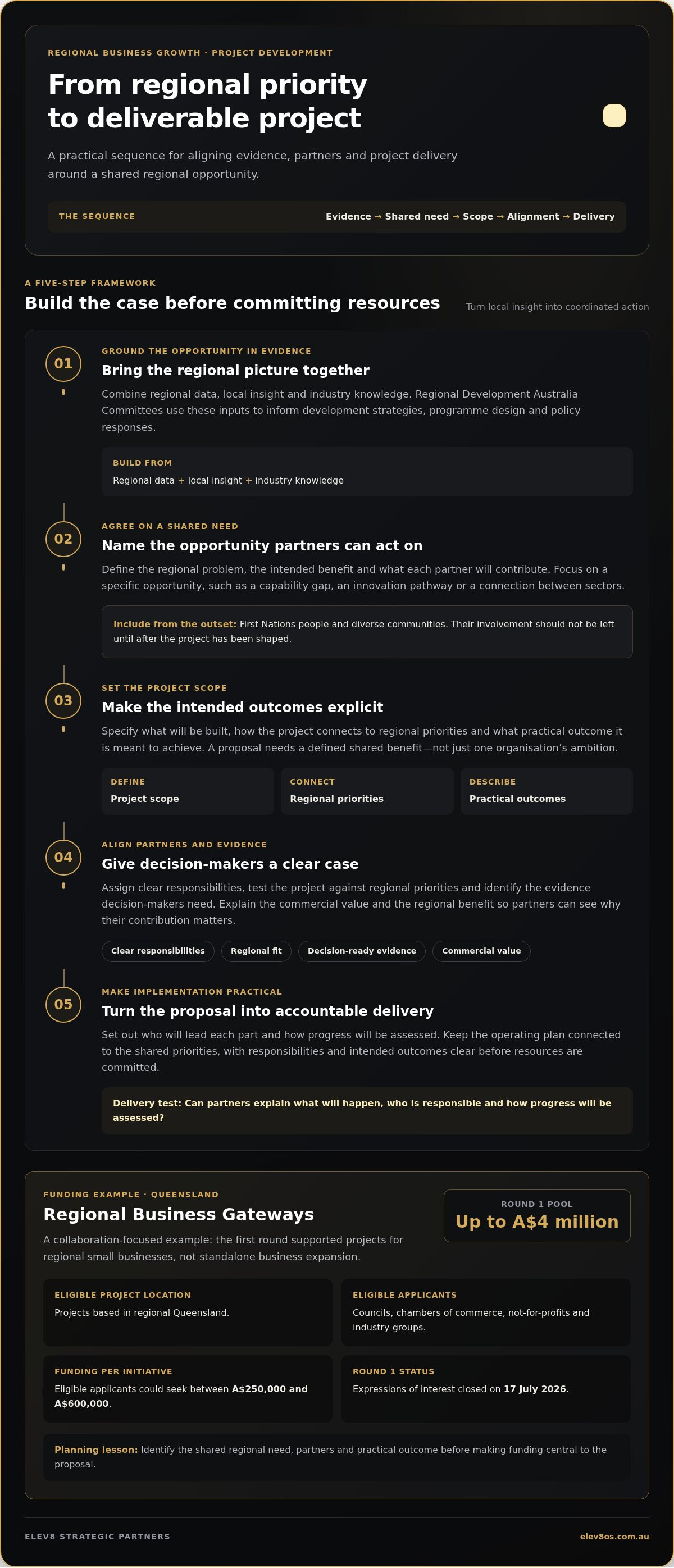
What are the key steps in a regional business growth strategy in Australia?
A regional growth plan should connect market evidence, delivery capacity and commercial priorities. Treat each decision as part of one operating system, from choosing a location to measuring results.
- Set a clear growth objective. Define what the business intends to change, such as entering a regional market, increasing local sales or adding a supply relationship. Set a practical measure of progress, then name the leader responsible for tracking it.
- Choose the market on evidence. Define the customer group and geographic catchment before committing resources. Compare customer needs, existing alternatives, buying patterns and access to suppliers. A regional opportunity is credible when customers have a clear reason to choose the offer.
- Test local delivery conditions. Map the workforce, transport links, premises, infrastructure and supply dependencies required to operate. Identify which constraints could interrupt service or increase operating complexity. Build the operating model around the actual location, not assumptions carried over from a major city.
- Build relationships around shared priorities. Identify businesses, community organisations, industry groups and public bodies with a direct stake in the opportunity. Regional Development Australia Committees contribute local intelligence to regional development strategies. Use relevant local insight to sharpen the project’s purpose and partnerships.
- Develop the project scope. State the problem, proposed response, intended beneficiaries and delivery responsibilities. A well-defined scope helps partners understand what the project requires and what success would look like. Keep the commercial case distinct from broader regional benefits, while showing how they connect.
- Match funding to the project. Compare a program’s purpose, applicant criteria, geography and timing with the proposal. Queensland’s Regional Business Gateways program, for example, supports collaborative projects for regional small businesses. Treat funding as one possible project input, not the foundation of commercial viability.
- Plan for risk and continuity. Identify critical suppliers, workforce dependencies, transport bottlenecks and exposure to local disruption. Set out practical responses, including alternative suppliers or adjusted delivery arrangements where viable. A growth plan should explain how the business will protect customers when conditions change.
- Review performance and adjust. Track sales, customer retention, delivery reliability and workforce capacity against the original objective. Record what local partners and customers report. Use that evidence to strengthen the offer, change resourcing or pause expansion before weak assumptions become fixed costs.
The sequence matters. Demand without delivery capacity creates strain; a partnership without a clear scope can drift. For a regional business growth strategy in Australia, link every commitment to an owner, an operating measure and a decision point. This makes the plan a working management tool, not a document that gathers dust.
Which Australian regional areas offer the strongest business growth opportunities by industry?
No single regional centre leads in every industry. The right location depends on customer demand, available skills, supply links and the infrastructure a specific business needs.
Coffs Harbour offers an industry-specific signal: growth in business lending there has been partly driven by healthcare. That makes healthcare a sector worth examining locally, not proof that every health business will succeed. Assess the catchment, workforce availability, referral relationships and service gaps before committing to a site or expansion.
Use industry evidence to shortlist opportunities, not declare a winner. The National Reconstruction Fund’s priority areas include value-adding in resources; agriculture, forestry and fisheries; transport; medical science; renewables and low-emission technologies; defence capability; and enabling capabilities. These categories can help businesses identify where regional expertise or supply-chain strengths may align with wider investment priorities.
Translate broad sectors into place-specific questions. For agriculture and food processing, examine access to producers, transport and suitable processing capacity. For transport businesses, map freight routes, customer locations and supply-chain connections. For healthcare, assess local service demand and the skills needed to deliver care. Each test should reflect a defined market, not an assumption about regional growth.
Compare candidate locations against the same commercial factors:
- Customers: Identify who will buy, where they are based and what problem remains unmet.
- Industry links: Map suppliers, partners and potential customers connected to the target sector.
- Workforce: Match required skills with local recruitment and training pathways.
- Delivery: Test transport, premises and infrastructure against operational needs.
- Competition: Identify existing providers and decide how the offer will earn a distinct place.
Test the shortlist against actual operating conditions. An area may show demand but lack the workforce or logistics to serve it. Another may have strong industry links but require a partnership to reach customers efficiently. Record these constraints alongside the opportunity and include them in the investment decision.
For example, a healthcare operator considering Coffs Harbour should distinguish lending activity from direct customer demand. Assess service gaps, workforce capacity and referral pathways, then compare the findings with delivery costs and complexity. This turns a location signal into a decision grounded in the business model.
There is no defensible nationwide ranking across all industries from these examples. Build an industry-led shortlist, test local evidence, then commit resources where commercial demand and delivery capability meet. Develop a disciplined regional growth strategy that connects location choices to clear priorities and execution.
Elev8 Strategic Partners: Strategic Business Partner Programme
Elev8 Strategic Partners’ Strategic Business Partner Programme gives business leaders structured strategic alignment and leadership support. It fits when regional expansion has exposed gaps between growth priorities, governance and day-to-day decisions.
The work centres on building a clear framework for sustainable operational success. Leaders can use it to sharpen priorities, strengthen accountability and keep decisions connected to execution. The Elev8 Boardroom offers a setting for collaborative insight and high-level decision-making, while the Foundations Toolkit supports the practical work of establishing sound business foundations.
A structured partnership can help when the opportunity is clear but leadership capacity, alignment or follow-through is holding back progress. It provides a strategic growth and governance framework, not a substitute for project-specific technical or regulatory advice.
To discuss the next step, visit elev8os.com.au.
Turn regional opportunity into deliberate action
Choose one opportunity and make its assumptions visible. Specify what must be true for it to work, who owns each decision and what evidence would justify the next commitment. A regional business growth strategy in Australia is useful when it shapes real choices, not when it sits untouched in a planning document.
This discipline also helps leaders respond as market conditions change. Revisit priorities when customer needs, workforce capacity or delivery constraints shift. Keep the work grounded in accountability, sound governance and decisions that support sustainable operations.
If growth is on the table but strategic alignment or leadership follow-through needs work, contact Elev8 Strategic Partners to discuss a practical next step. Regional businesses can build durable growth by making deliberate choices and putting capable leadership behind them.
Frequently Asked Questions
Why Regional Australia?
Regional Australia gives businesses the opportunity to meet local needs, connect with nearby industries and build stronger customer and supplier relationships. A regional business growth strategy for Australia should assess specific markets rather than treat regional communities as one uniform opportunity. For example, when comparing Tamworth, Newcastle, Armidale, Coffs Harbour, Port Macquarie and Moree, assess each centre’s customer base, industry links and delivery requirements before deciding where to invest.
What grants and government funding support regional business growth in Australia?
Funding programs can support regional projects, but each has its own purpose, eligible applicants and application period. Some target shared initiatives led by organisations such as councils, chambers or industry groups, rather than a single business’s routine operating costs. Start by matching the project outcome to the program’s stated purpose, then identify which organisation can apply and what evidence the proposal needs. Treat funding as project support, not a substitute for a sound commercial case.
What infrastructure, transport and digital connectivity challenges affect regional business growth in Australia?
Regional businesses may face longer freight routes, fewer transport options and connectivity limits that disrupt sales, communication or daily operations. Map critical links, including deliveries, online transactions and customer contact, then identify where delays or outages could interrupt service. A supplier serving distant towns, for example, needs delivery schedules and communication processes that account for travel time and patchy connectivity.