Joshua Lawrence
By Joshua Lawrence · 13-minute read
Somebody has told you to get a coach. Maybe you've already tried one. Maybe you've joined a mastermind, a networking group or a Facebook community for shop owners. You run a barbershop doing $500K–$2M, you're still behind the chair most days, and you're tired of advice that sounds good on a call and changes nothing in the shop. You don't need another business coach for your barbershop. You need something that actually moves the numbers.
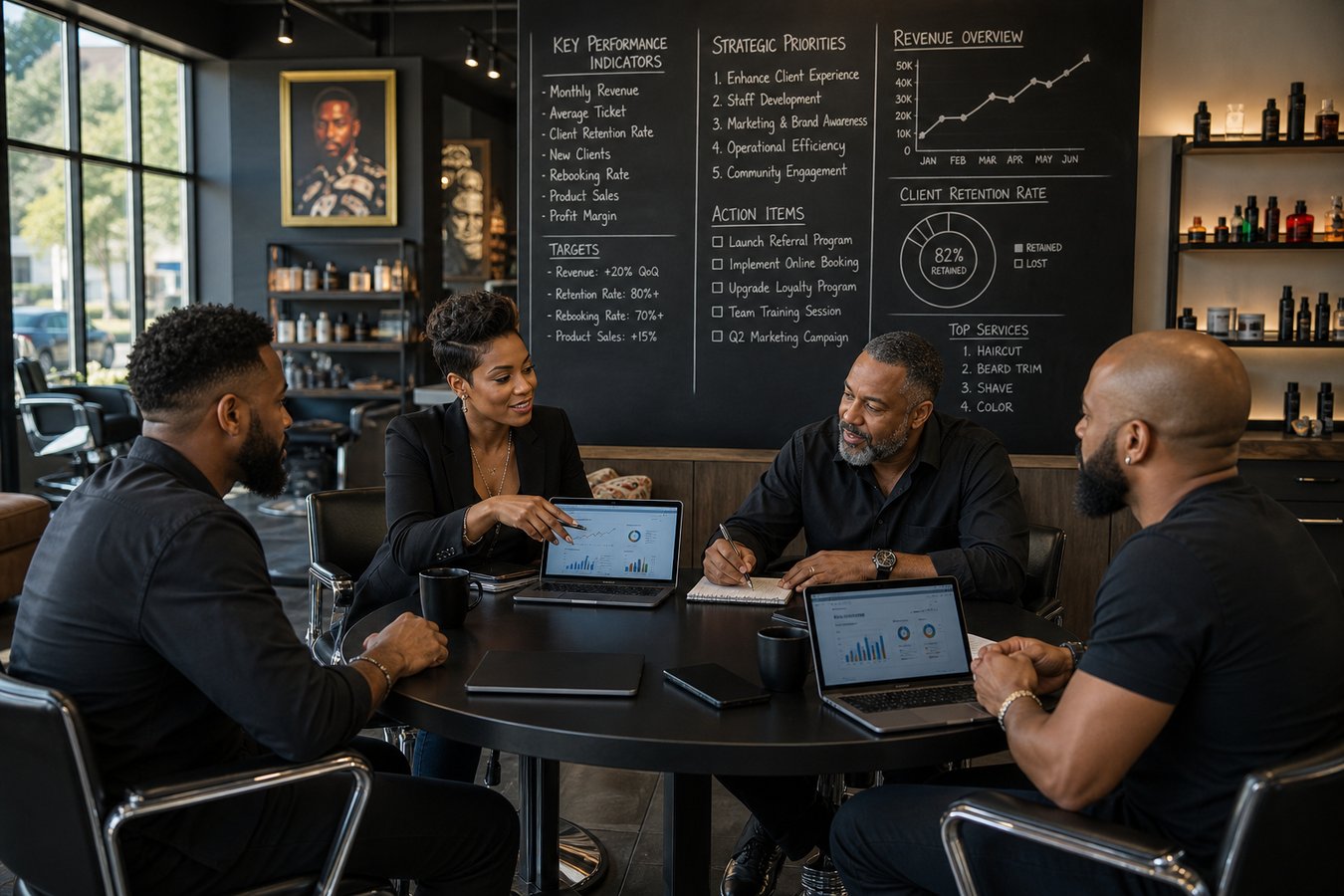
That something is a board. Not a coach who gives you frameworks, and not a peer group that gives you conversation, but a room of owners at your stage, with real numbers on the table and someone in the chair who follows up on what you committed to. That's what the Elev8 Boardroom is built to be.
You've Been Told to Get a Coach. Here's Why It Often Doesn't Land
Coaching is a huge industry, and plenty of coaches are genuinely good at what they do. But barbershop owners tell us the same story over and over. They paid for coaching, felt motivated for a few weeks, and then the shop pulled them straight back into the same patterns.
The problem isn't effort. It's format. Most coaching is built around the owner's thinking: mindset, goals, habits. That's useful, but a barbershop doesn't stall because of the owner's mindset. It stalls because of structure: who decides what, how the numbers are reviewed, and whether anyone follows up.
The Australian Small Business and Family Enterprise Ombudsman works across many of the pressures small business owners face, from cash flow to wellbeing. Most of those pressures are operational and financial. They need operators who understand the numbers, not just encouragement.
One of our campaigns puts it in five words: not a coach, a board. The difference sounds small. In practice, it changes everything.
A Coach Sees Your Business Through You
Here's the first limitation of most coaching relationships: a coach sees your business through you. They don't have access to your profit and loss. They don't know what actually happened in the shop this week. They know what you tell them, filtered through how you feel on the day.
That's a serious blind spot. Owners are often the least reliable narrators of their own business, not because they're dishonest, but because they're too close to it. A busy week feels like a good week, even when wages blew out and utilisation dropped.
A board works from the numbers. Revenue per barber, utilisation, rebooking rate, wages as a percentage of revenue. The ATO's small business benchmarks for barber and men's hairdressing give a reference point for what normal costs look like. A good board pushes you past normal, using your real data.
When the numbers are on the table, the conversation changes. It stops being about how you feel and starts being about what the business needs.
Generic Peer Groups Mix Industries and Stages
Peer groups solve the isolation problem. Being a business owner is lonely, and talking to other owners helps. But most generic peer groups mix industries and stages so widely that the advice rarely applies.
A barbershop owner doing $800K sits next to a software founder, a builder doing $12M and a consultant who works alone. Everyone's polite, everyone shares, and very little of it fits your shop. The software founder's hiring advice doesn't work for barbers. The builder's cash flow problems aren't yours.
Stage matters as much as industry. Harvard Business Review's classic model of how organisations evolve as they grow shows that each stage of growth brings its own crisis and needs its own solutions. Advice from an owner three stages ahead can be as unhelpful as advice from an owner three stages behind.
The most useful room is one where everyone faces similar problems at a similar scale, and can hold each other to account on the same kinds of decisions.
Not a Talk Shop: How a Board Works Differently
Our second campaign in this series says it directly: not a talk shop. A board isn't a place to vent. It's a place to decide, commit and follow through. Three things make it work differently from coaching or a peer group:
- Agenda-Driven: Every session follows a set structure. Numbers first, then the biggest decision on the table, then commitments.
- Numbers-First: Every owner brings their real data. Opinions come after the numbers, not instead of them.
- Commitments Checked: What you said you'd do last time gets checked this time. Every time.
McKinsey's research on decision making in the age of urgency found that the organisations that excel at decisions make them at the right level and follow through with commitment. A board brings that discipline to a small business that has never had it.
That last part, checking commitments, is where most coaching and peer groups fall short. Accountability that has no follow-up isn't accountability at all.
Inside the Elev8 Boardroom: Four Owners, One Chair
The Elev8 Boardroom is built around a simple structure. Four owners at a similar stage, with Josh in the chair. Two Boardroom sessions a month. A monthly one-on-one Director Debrief to go deep on your numbers and decisions. Monday check-ins to keep the week on track.
Around that rhythm sits the work itself: a 90-day plan built in your first quarter, a quarterly system project that installs one major operating system in your shop each quarter, and the Elev8 OS Platform, where your dashboard, plan and actions live.
The barbershop room is curated specifically for owners at $500K–$2M. That's deliberate. It means the owners around the table are wrestling with the same problems you are: rosters, floor leads, pricing, chair utilisation and stepping out from behind the chair.
Research in Harvard Business Review on the neuroscience of trust links trust with higher engagement and performance. Four owners who know each other's numbers build that trust quickly, and that's what makes honest challenge possible.
How to Choose the Right Barbershop Business Advisor
Whether you choose Elev8 or not, here's how to assess any barbershop business advisor, coach or programme before you commit. Work through these steps in order.
- Ask What They'll See: Will they review your actual financials and operating numbers, or only what you tell them?
- Ask Who Else Is in the Room: Are the other owners at your stage and in a similar type of business?
- Ask How Commitments Are Tracked: What happens if you don't do what you said you'd do?
- Ask What Gets Built: Will you end up with systems, a plan and a dashboard, or just notes from conversations?
- Ask About Operating Experience: Has the person in the chair actually run a business at the level you're aiming for?
- Ask About Support Between Sessions: When something goes wrong mid-month, who do you call?
Retention is a good test too. Gallup's research shows how costly it is when people leave because nobody engaged with them about their future. The same is true for owners in programmes: the ones that stick are the ones where someone keeps showing up.
"But You're in Australia, and I'm in Auckland, Toronto or Dubai"
It's the most common objection we hear from overseas owners, and it's a fair one. Here's the direct answer: the Boardroom runs entirely online through the Elev8 OS Platform. Sessions are facilitated remotely. The Monday check-ins, the 90-day plan and the quarterly system project are all delivered through the platform.
The 48-hour Ops Support SLA applies regardless of time zone. When an issue lands, the Elev8 team responds within 48 hours whether you're in Tamworth or Toronto. Nothing sits still waiting for an answer.
We work with barbershop owners in Australia, New Zealand, the USA (East Coast), Canada, Singapore and the UAE. The barbershop room is curated for owners at $500K–$2M regardless of geography, because the stage of business, not the postcode, determines whether the advice lands.
Demand for barbering is growing in most of these markets. In the United States, the Bureau of Labor Statistics projects faster-than-average employment growth for barbers and hairstylists to 2034. Growing demand everywhere means the same structural problems everywhere.
Ready to stop being the bottleneck in your own business?
The Elev8 Boardroom gives $1M–$15M service business owners the tools, accountability, and operator community to install a business that runs without them. Book a complimentary strategy session to see if you're a fit.
No pressure. No hard sell. Just a straight conversation about where your business is and where it needs to go.
Barbershop Business Consulting and Advisory: Questions Answered
These are the questions barbershop owners ask when they're weighing up coaching, consulting or an advisory board. Each answer stands on its own.
Do I need a business coach for my barbershop?
You need help that matches your problem. If your challenge is motivation or personal habits, a coach can help. If your challenge is structure, such as decisions routing through you, numbers you rarely review, and a team that can't run without you, you'll get more from an advisory board that works from your real numbers and follows up on commitments.
What kind of business advice do barbershop owners need?
Barbershop owners need advice on pricing, rostering, chair utilisation, team structure and stepping back from the chair. It should come from people who understand service businesses at your stage. The Australian industry alone is worth around $12.5 billion according to IBISWorld, and most of it runs on owner-operated shops facing the same issues.
What is a business advisory board?
A small business advisory board is a group that meets regularly to review your numbers, challenge your decisions and hold you accountable. Unlike a corporate board, it has no legal authority. Its value comes from structure: a set agenda, real data and commitments that get checked every session.
"I Was the Bottleneck in My Own Business"
Josh, who chairs the Elev8 Boardroom, has built and run businesses across fitness, security, training and barbering, including direct ownership in the barbershop industry. He says it plainly: "I was the bottleneck in my own business."
He's lived the same wall barbershop owners hit. Doing the work, making every decision, and watching growth stall because the business couldn't move faster than he could. Getting through that wall is what shaped the Elev8 approach.
That's the difference between a coach and an operator in the chair. An operator has sat where you sit. They know which advice survives contact with a busy Saturday and which doesn't.
And you're far from alone in needing it. The Australian Bureau of Statistics counts more than 2.8 million actively trading businesses, most of them small and owner-run. Very few of those owners have ever had a board.
What Changes When You Sit at the Right Table
When barbershop owners sit at the right table, the change is practical, not inspirational. Kingdom Barbers, one of our founding barbershop clients, reclaimed more than 10 hours a week within 90 days through team systems, barber KPIs and a business dashboard. The owner moved from the chair to the decision-maker role.
That result didn't come from motivation. It came from a structure: numbers reviewed every month, decisions moved to the right people, and commitments checked until they were done. The same structure drives every Boardroom.
The financial levers follow. Once the numbers are visible, pricing becomes a deliberate decision rather than a nervous one. McKinsey's analysis of pricing found that a 1% price increase, with volume held, lifted operating profit by around 8% for a typical large company. Small shops feel that effect too.
The right table doesn't make you work harder. It makes your work count.
Run Your Barbershop, Don't Just Work In It
Coaching gives you frameworks. Peer groups give you conversation. A board gives you a room of owners at your stage, real numbers on the table, and someone in the chair who checks what you committed to. For a barbershop owner stuck behind the chair, that difference is everything.
The barbershop room inside the Elev8 Boardroom was designed for shop owners at $500K–$2M who want to run their business rather than work in it. Four seats, operator to operator. And it's open to owners anywhere in the world.
Picture a month where your decisions get sharper, your numbers get clearer and your shop needs you a little less every week. That's what a board makes possible.
Book a 20-minute call to apply for a seat in the barbershop Boardroom. Four seats, operator to operator.