Joshua Lawrence

If your team needs you to interpret every important task, you don’t have a standard. You have a bottleneck. For Armidale owners, learning how to build operational standards in business starts with fixing the work that varies between people, not writing procedures for every possible situation.
You already know the cost of inconsistency: customers get a different experience, key tasks depend on knowledge held by a few people, and unclear instructions send decisions back to you. A folder of polished documents won’t fix that if the team can’t use them in the flow of work.
This guide gives you a practical template for setting standards around important workflows, assigning an owner and checking whether the work is producing the result you need. You’ll also see how to introduce standards without turning every task into a rigid rule. The core is simple: define who owns the work, what triggers it, what good execution looks like and how the team feeds back problems. Then improve the standard as the work changes, so it stays useful rather than gathering dust.
Key Takeaways
- Learn how to build operational standards in business by starting with a workflow where inconsistent execution creates real friction.
- Use a practical template to define each standard’s purpose, trigger, owner, inputs, steps, expected result and evidence.
- Set clear exception steps so staff know when to pause, who makes the call and how to record the issue.
- Test standards against the work as it happens, then track a small number of useful measures such as errors or turnaround time.
- Roll out standards with the people doing the work, then review and refine them as the process changes.
How operational standards create consistency without adding bureaucracy
When work varies from person to person, the business pays for it in rework, extra hand-offs and decisions that keep landing on the owner’s desk. One employee follows up with a customer promptly; another assumes someone else has done it. The job still gets done, sometimes, but the result depends on who’s available and what they remember.
An operational standard is an agreed, observable way to complete important work and recognise an acceptable result. It gives the team a reliable baseline, not a script for every conversation. A Standard Operating Procedure (SOP) can document that method, but a document alone isn’t the standard. The standard must guide an action or decision in the work itself.
That distinction keeps standards practical. A policy sets a boundary, such as how customer information is handled. An aspiration names a desired outcome, such as excellent service. A task list says what to do, but may not explain who owns the result or what “complete” means. A useful standard connects the work to a clear result, while leaving room for judgement where the situation calls for it.
To work out how to build operational standards in business, start with what customers need, what the business must protect or deliver, and what the team can realistically carry out. A standard that demands steps the team doesn’t have the time, tools or authority to complete won’t create consistency. It will create workarounds.
What belongs in an operational standard?
Make the standard specific enough to guide the work and light enough to use while doing it. State the expected result, the person or role accountable, and when the standard applies. Then describe essential steps and the evidence that confirms the work is complete. Evidence could be a recorded outcome, a completed check or a customer response logged in the usual system.
Be clear about where judgement is allowed. A customer follow-up standard might require a response by an agreed point in the process and a note of the outcome, without dictating every word staff must use. The test is simple: can someone doing the work tell what to do, what they own and when to raise an exception?
Which business processes should you standardise first?
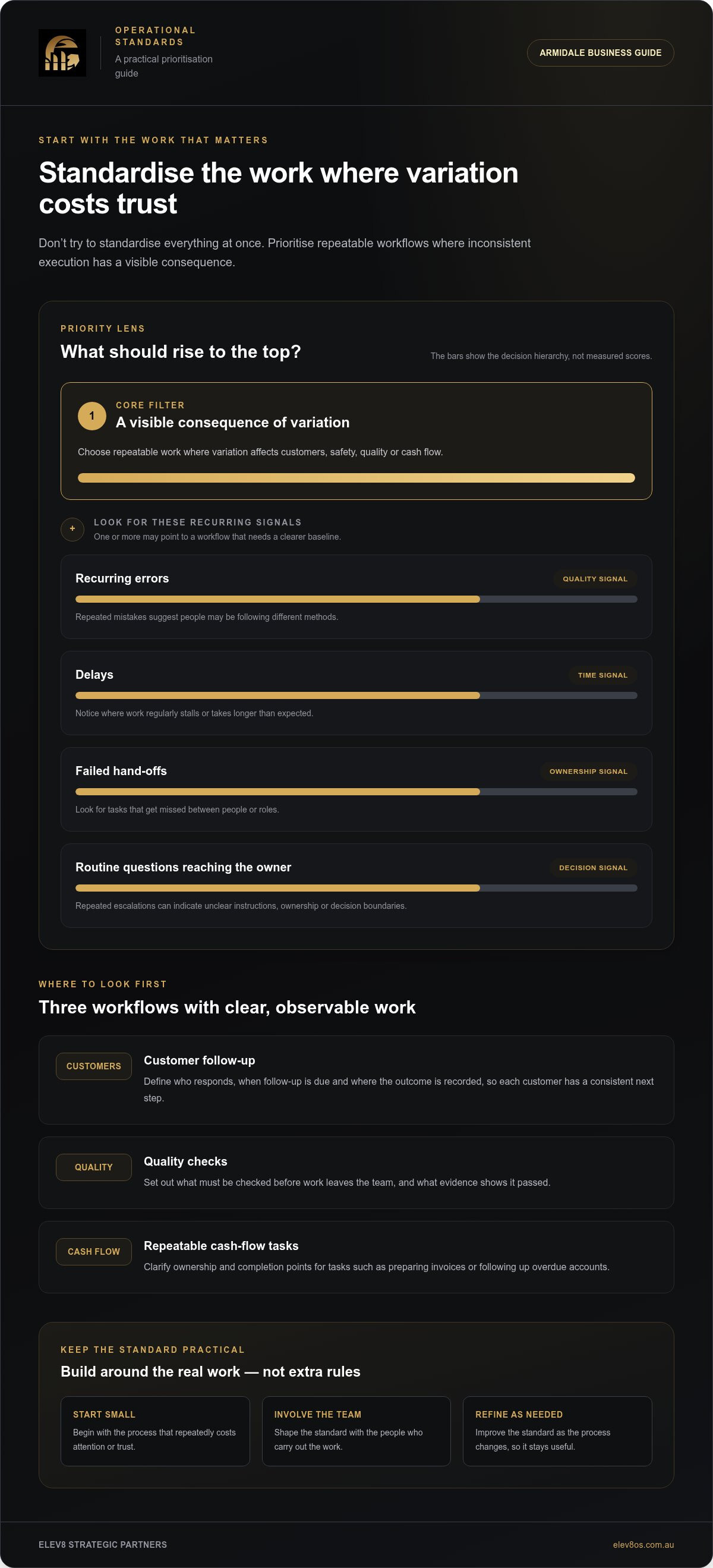
Don’t standardise everything at once. Choose repeatable work where variation has a visible consequence for customers, safety, quality or cash flow. Look for recurring errors, delays, failed hand-offs and routine questions that escalate to the owner. Those are signs the process needs a clearer operating baseline.
- Customer follow-up: In a regional business serving customers across dispersed teams, define who responds, when follow-up is due and where the outcome is recorded. That gives each customer a consistent next step, even when different staff handle the enquiry.
- Quality checks: Set out what must be checked before work leaves the team, and what evidence shows it passed.
- Cash-flow tasks: Clarify ownership and completion points for repeatable steps such as preparing invoices or following up overdue accounts.
Start with the process that repeatedly costs attention or trust. Build the standard around the real work, then refine it with the people who carry it out. That’s how you add control without adding needless rules.
A practical operational standards template your team can use
A standard needs to work at the point of action, not just look complete on a page. Use the template below to capture one workflow from start to finish. Keep it short enough to follow during a busy shift, and specific enough that another team member can see what good completion looks like.
For a wider view of how standards relate to measurement, the National Institute of Standards and Technology (NIST) provides reference material on standards and measurement science. For your team, the practical test is whether each field helps someone do the work or make a decision.
The core fields: purpose, trigger, owner and result
Write the purpose as a business outcome, not “improve performance”. Name the event that starts the process and the role responsible for carrying it through. List the inputs needed, then describe the result in terms another team member can recognise. This makes ownership visible and stops a half-finished task being mistaken for a completed one.
Copyable operational standard
- Purpose: What business or customer outcome does this workflow deliver?
- Trigger: What event starts the workflow, and when does this standard apply?
- Owner: Which role is accountable for completing the work?
- Inputs: What information, materials or approvals are needed?
- Steps: What essential actions must happen, in order?
- Result: What does a correctly completed job look like?
- Evidence: What record or check shows the result has been achieved?
- Exceptions: When should work pause, who decides what happens next, and where is the issue recorded?
Steps, evidence and exceptions: make the standard usable
Keep the steps direct and observable. “Check the order against the approved quote” is clearer than “process the order carefully”. Name the hand-off, too. If another role must act next, say what they receive and how they know the work is ready. Link to business frameworks and templates when a related tool supports the workflow, rather than copying its instructions into every standard.
Example, preparing an order for dispatch: The trigger is an approved order entering the dispatch queue. The dispatch coordinator checks the order against the pick list, confirms the items and quantities, then marks it ready for collection. The result is a verified order in the dispatch area; the completed check is recorded against the order. If an item is missing or the details don’t match, pause dispatch, record the discrepancy and send it to the nominated supervisor to decide the next step. This is an illustration, not a universal requirement.
Keep each standard to one workflow. If it depends on a separate stock-check or approval process, link to that procedure instead of repeating its steps. That keeps changes controlled and reduces conflicting instructions. If you’re building a set of practical operating frameworks, the Foundations Toolkit offers a self-guided starting point.
How to test whether operational standards improve the work
A standard isn’t proven because it’s been written, approved or shared with the team. Test it against the work as it happens. Watch the process from trigger to finished result, then speak with the people doing it. Look for steps that are skipped, repeated or handled differently from the written instruction. Ask what caused the variation before changing the rule.
Evidence-based review means checking actual work against an agreed, observable result, then using the gap to decide what to fix. That gap might point to a confusing instruction, a missing input, a capacity constraint or a decision no one has authority to make.
Choose evidence that shows whether the standard is working
Use evidence that already exists where possible: completed work samples, system entries, customer feedback or records of hand-offs. Set a baseline before changing the process. For example, note how often a particular step is missed or how long the workflow currently takes. Don’t invent a target or compare your results with an unsupported benchmark. First establish what’s happening in your own business.
Keep the review focused. Choose a small number of measures tied directly to the standard, such as completion, errors or turnaround time. A measure should help the owner see whether the expected result is being achieved, not create reporting work with no decision attached.
Simple review map
- Workflow: Supplier invoice processing. Owner: Accounts role responsible for processing. Evidence: Invoice record and approval entry. Measure: Invoices processed with the required approval recorded.
- Workflow: Equipment handover. Owner: Team member handing over the equipment. Evidence: Completed handover record. Measure: Handover records complete and missing items identified.
- Workflow: Job completion check. Owner: Person accountable for final review. Evidence: Completed checklist or recorded sign-off. Measure: Jobs passed at first review or returned for correction.
Diagnose variation before changing the rules
A disappointing measure doesn’t automatically mean the standard needs more steps. Check whether it’s clear, practical and available where the work happens. Then check whether staff have the training, resources, time and authority to follow it. A capable employee can’t meet a standard if a required input is missing or a decision is waiting on the owner.
Separate the cause before choosing the fix. Rewrite unclear instructions. Train where people don’t know how to perform a step. Address capacity when workload makes the standard unrealistic. Clarify accountability when ownership is drifting between roles. Change the standard only when the agreed method itself is at fault.
This review creates a useful operating rhythm: observe, compare, diagnose, adjust, then check again. It also helps work move beyond the owner’s memory and judgement. Well-tested scalable business systems make responsibilities and results visible, so the team can carry more of the work without sending every uncertainty back to the founder. For broader background on documented procedures, see Michigan State University Extension on SOPs.
How to introduce operational standards across a busy team
Introducing standards across every workflow at once is a reliable way to overload a busy team and leave instructions unused. Start small, work with the people doing the job and make ownership visible. A controlled rollout lets you find what’s unclear before the same problem spreads across other processes.
Pilot one high-impact workflow before expanding
Choose a contained, repeatable process with a clear consequence if it goes wrong. Map how the work actually moves, including hand-offs and decisions, before drafting instructions. The people closest to the process can point out constraints that aren’t obvious from the owner’s desk.
Use this rollout sequence:
- Select one workflow. Pick a process that matters and happens often enough to learn from.
- Map the current work. Follow the real steps, roles, inputs and hand-offs.
- Draft the standard. Set out the expected result, key actions, ownership and exception path.
- Test it during real work. Record confusion, workarounds, missed steps and unusual cases.
- Train the team and revise. Use employee feedback to make the instruction practical before wider use.
- Review and expand. Check whether the standard works, then apply the approach to the next priority workflow.
Don’t treat a workaround as automatic proof that staff are resisting. It may expose a missing input, an unrealistic step or a decision point the draft failed to cover. Revise the standard with the team before calling it final.
Build training and review into existing work
Introduce the standard where the process happens, using a real example rather than relying on an email attachment. Ask a team member to walk through the steps and explain what they’d do if an exception occurred. That quickly reveals whether the instruction is understandable and whether the employee knows when to act or escalate.
Assign one named owner to keep each standard visible, current and connected to team routines. The owner doesn’t need to perform every step, but they must make sure the instructions are accessible, questions are captured and review actions are followed through. Use routine team check-ins to surface issues and assign a person to each corrective action. The Foundations Toolkit for Business guide offers a related resource for owners building practical business frameworks.
Keep standards current as the business changes
A standard can become outdated when the process, customer requirements or operational responsibilities change. Record its owner and review date, and bring forward a review when a change affects how the work is done. Retire or replace superseded instructions so staff aren’t left choosing between conflicting versions. That discipline is central to how to build operational standards in business that stay useful after rollout.
If your team needs hands-on support to put standards into day-to-day work, book a 30-45 minute diagnostic Discovery Call. It’s a diagnostic conversation, not a sales call.
When embedded operational support can help standards take hold
A written standard can show the right way to run a workflow. It cannot create the time, ownership or follow-through needed to put that method into daily practice. If the same bottlenecks keep returning, execution varies between teams and every unresolved question lands with you, the constraint may be implementation capacity, not a lack of ideas.
That is the point where an owner-led business may need practical support inside the operation. Not another report about what should change. People who can build the systems, establish accountability and help the team use them in real work.
What embedded implementation means in practice
Elev8 Strategic Partners works inside established, founder-led businesses. In a Strategic Operations Engagement, a Strategic Operations Engineer works within the business to implement operational systems and accountability. The work is execution-focused: standards need to be built into how the team handles tasks, decisions and hand-offs, rather than left as recommendations for the owner to carry alone.
The approach is direct. Elev8 Strategic Partners tells clients what they need to hear, not simply what they want to hear. That matters when the actual barrier is uncomfortable to name, whether it is unclear ownership, a process that depends on the founder, or a standard that does not fit the way the team works. The aim is practical infrastructure the business can run, not a stack of documents that needs outside prompting to stay alive.
Engagements are measured by outcomes, not time served. Tier 1 engagements typically run 6-18 months and conclude when agreed outcomes are delivered and the business is positioned to grow without Elev8 Strategic Partners. Tier 1 work is also limited to one active client per industry vertical at any time. That is a deliberate constraint on the engagement, not a promise of a particular result.
A diagnostic next step for established business owners
If repeated operational issues are taking leadership time away from the work only you can do, start by getting clear on the actual constraint. The Discovery Call is a 30-45 minute diagnostic video conversation. There is no pitch deck or slide presentation. It is used to discuss the business's current state, your goals, past attempts, constraints and whether there is a fit for the work.
That conversation is not a sales call. It is a direct assessment of what is happening and what needs to change, including whether the business needs more than a written framework. For suitable established owners ready to put operational standards into practice, book a diagnostic Discovery Call.
Build a business that doesn’t depend on your memory
The real test of how to build operational standards in business is whether your team can keep good work moving without every decision circling back to you. That shift doesn’t come from writing more instructions. It comes from making execution part of how the business runs, then building the team’s ability to maintain and improve it.
For some owners, the next step is clear: choose one persistent operational constraint and put focused attention behind resolving it. Elev8’s work is embedded in the business and built around agreed outcomes, not reports alone. Strategic Operations Engagements typically run 6-18 months, ending when agreed outcomes are delivered and the business is positioned to grow without Elev8. Tier 1 engagements are limited to one active client per industry vertical at a time.
If you’re ready to examine what’s holding execution back, book a diagnostic Discovery Call. Use the conversation to get clear on the challenge and the practical work required. Your next step doesn’t need to be a grand overhaul. Start with a real constraint, and build from there.
Frequently Asked Questions
What is an operational standard in business?
An operational standard is an agreed method for completing a defined task and recognising when the result is acceptable. For example, a service team might set what information must be recorded before closing a customer request, while allowing staff to choose suitable wording. The standard should fit the business’s actual workflow and customer commitments, not copy a generic procedure that ignores how the work gets done.
How do I write an operational standard?
To work out how to build operational standards in business, begin with one recurring workflow that affects customers, quality, cash flow or risk. Ask an experienced employee to describe what happens in a typical case and an unusual one. Draft the instructions, then have another team member use them without coaching. Their questions will expose missing context. Revise the draft before sharing it more widely.
How many operational standards does a small business need?
There’s no useful universal number. Build standards in response to recurring problems, not to fill a library. For a business operating around Tamworth, Newcastle, Armidale, Coffs Harbour, Port Macquarie or Moree, prioritise processes where inconsistent hand-offs or decisions could affect customers or delivery. Add another standard when a real workflow needs clearer guidance, and remove or replace documents that no longer match the work.
Should operational standards include every step of a process?
No. Record the actions, decision points and hand-offs that materially affect the result. For a customer complaint, that might include logging the issue, identifying who owns the response and escalating a matter outside the employee’s authority. There’s no need to script routine wording if staff can handle it appropriately. Review the detail with someone who performs the task, so the standard stays useful rather than cumbersome.
How often should a business review its operational standards?
Review a standard when the process, ownership, customer requirements or operating conditions change. Also schedule checks based on the workflow’s importance and how quickly its instructions could become outdated. Ask the owner to confirm that the document still matches actual practice and that its completion records remain useful. When an update affects a team, explain what changed and remove superseded copies from the places staff use them.
What should I do if employees do not follow a standard?
Find out what’s getting in the way before assuming the problem is attitude. An employee may not know which version applies, may lack a required input or may face a workload that makes a step impractical. Observe the task and ask the people doing it what happens in practice. Then address the cause, clarify who owns the work and communicate the expected outcome consistently.
Can operational standards still allow employees to use judgement?
Yes. A standard can set required controls and decision boundaries without dictating every action. For instance, staff might need to record a customer request and escalate certain issues, while using judgement about how to respond to routine enquiries. Make the distinction clear: identify what must happen, where discretion applies and when a case needs approval. That gives employees room to respond appropriately without losing consistency.